
UK Show Bet Payout: The Complete Guide to Place & Each-Way Returns
No picks. No hype. Just the payout math.
 Available in US
UK Show Bet Payout: The Complete Guide to Place & Each-Way Returns
If you have landed here searching for a UK show bet payout, you are not alone — and you are not quite looking for what you think you are looking for. The term "show bet" belongs to American pari-mutuel racing, where it means backing a horse to finish in the top three. In the United Kingdom, that concept does not exist as a standalone wager. What the UK offers instead is the place part of an each-way bet, a mechanism built on fixed odds rather than pooled money, governed by an entirely different set of rules, and capable of returning very different numbers for the same race on the same afternoon.
That distinction matters more than most guides let on. The payout maths behind every place finish in the UK hinges on place terms set by Tattersalls Rules, not on how much money other punters have thrown into a pool. The number of places paid, the fraction of win odds applied, the impact of a late withdrawal triggering Rule 4 — all of these variables sit between your stake and your return. Understanding them is the difference between knowing what you might win and guessing.
This is no niche corner of the betting world, either. British horse racing contributes an estimated £4.1 billion annually to the national economy and supports around 85,000 jobs, according to figures the BHA submitted during the Gambling Act Review and confirmed by the House of Commons Library. The audience is vast: the UK Gambling Commission's 2024 survey found that 48% of British adults had gambled within the previous four weeks, with 10.3% betting on sports and horse racing online — making it the most popular category after the National Lottery. When that many people have skin in the game, the mechanics of how payouts are calculated deserve a proper explanation, not a marketing paragraph wrapped around a sign-up button.
This guide breaks down every component of the UK place payout system: how each-way bets are structured, what place terms apply at different field sizes, how to calculate returns step by step, and where pool dividends diverge from fixed-odds settlements. Whether you are a US punter translating show-bet thinking into British terminology or a UK racegoer who has never checked the maths on a betting slip, the numbers that follow will make every place finish legible.
Pari-Mutuel Matrix
What the Numbers Tell You Before You Bet
- The UK has no standalone show bet — its equivalent is the place part of an each-way wager, settled at fixed odds rather than pari-mutuel pool dividends.
- Place terms depend on field size and race type: from two places at 1/4 odds in small fields to four places at 1/4 in big handicaps with 16+ runners.
- Rule 4 deductions (up to 90p in the pound) and dead-heat rules can cut your payout after the race — always factor them in before comparing returns.
- Tote pool dividends beat the starting price in 20 out of 35 races at Royal Ascot 2025, making pool betting a genuine alternative on big days.
- Enhanced place promotions from bookmakers can extend payouts to 10 places on races like the Grand National — but the adjusted odds mean the edge is smaller than the headline suggests.
Show Bet vs Each-Way Place Part: Bridging the US-UK Divide
The confusion starts with a single word. In the United States, a "show bet" is a wager that your horse finishes first, second or third — nothing more, nothing less. You place it through a tote window or an ADW account, your money enters a pari-mutuel pool, and after the track's takeout (typically 15–25%), the remaining pool is divided among everyone holding a winning ticket. The payout is not fixed when you bet; it depends on how much money was wagered on each horse.
In the UK, there is no equivalent single product called a "show bet." The closest mechanism is the place part of an each-way bet, but it operates under fundamentally different plumbing. When you bet each-way with a British bookmaker, you are placing two separate bets of equal size: one on the horse to win, and one on the horse to finish within the paid places. The place part is settled at a fraction of the win odds — typically 1/4 or 1/5 — using the fixed odds quoted at the time you placed the bet (or the starting price if you chose SP). No pool, no shared dividend, no dependency on other punters' behaviour.
That structural difference creates divergent outcomes from the same race. Consider a horse quoted at 10/1 finishing third in a 12-runner non-handicap where three places are paid at 1/5 odds.
US show bet: stake (pari-mutuel)
Your joins the show pool. After the track's 19% takeout, the residual pool is split among the three finishing positions proportionally. Depending on pool composition, your might return .00 — but the exact figure is unknowable until the pool closes.
UK each-way place part: £10 stake (fixed odds)
Place odds = 10/1 × 1/5 = 2/1. Return = (£10 × 2) + £10 stake back = £30.00. This number was locked in the moment you placed the bet.
The table below maps the key differences side by side.
| Feature | US Show Bet | UK Each-Way Place Part |
|---|---|---|
| Payout system | Pari-mutuel (pool) | Fixed odds (or SP) |
| Positions that pay | 1st, 2nd, 3rd (always) | Depends on field size and race type (2–4 places) |
| Odds known in advance | No — estimated until post time | Yes — locked at bet placement (or SP) |
| Place fraction | N/A (pool split) | 1/4 or 1/5 of win odds |
| Standalone place bet | Yes | Via Tote only (or place-only markets on exchanges) |
| Governing rules | State racing commissions | Tattersalls Rules on Betting |
| Typical takeout / margin | 15–25% pool takeout | Bookmaker overround (varies, often 15–20% on place markets) |
The practical consequence: a US show bettor can sometimes receive an unexpectedly large payout when a heavily backed favourite runs out of the money and the pool redistributes. A UK each-way punter never gets that windfall — the price is the price. Conversely, the UK bettor will never watch their return shrink because a late flood of money entered the pool on the same horse.
With the transatlantic terminology clarified, let us look at how the UK place payout is actually calculated — step by step, from odds to cash.
How the UK Place Payout Actually Works
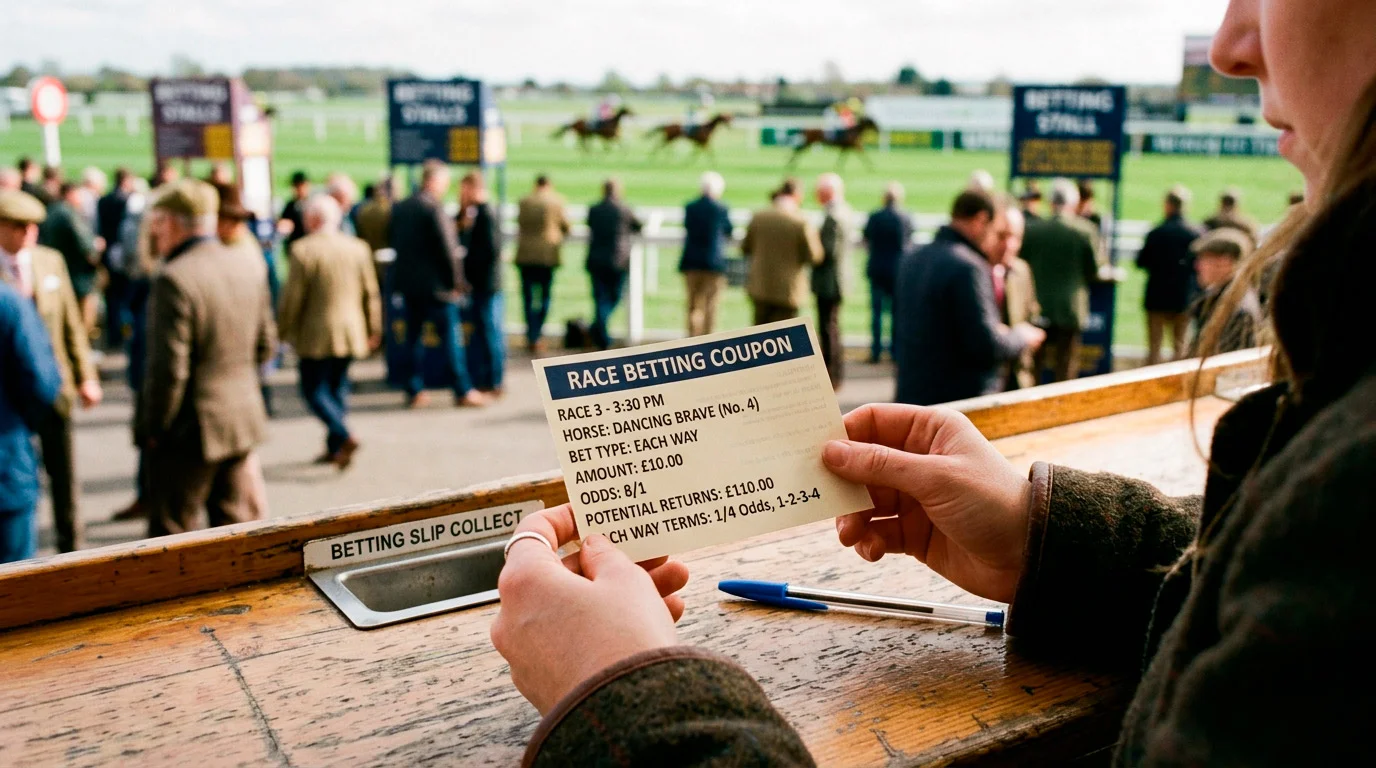
Every UK place payout, whether settled in a Ladbrokes shop or on a betting exchange, comes down to one formula. The variables change; the structure does not.
Place payout formula (fixed odds): Place Return = Stake × (Win Odds × Place Fraction) + Stake
Or, expressed differently: Place Return = Stake × (Place Odds + 1), where Place Odds = Win Odds × Place Fraction.
Three components drive the result. The win odds are the price your horse is quoted at for the outright win — say 8/1 in fractional terms or 9.0 in decimal. The place fraction is dictated by Tattersalls Rules and depends on the number of runners and the race type: most commonly 1/5 for standard races with 8–15 runners or 1/4 for handicaps with 16 or more runners. The stake is whatever you wagered on the place part of the each-way bet. Since each-way means two equal bets, a "£10 each-way" costs £20 total — £10 on the win, £10 on the place.
Worked Example: 8/1 at 1/5 Place Fraction
Horse: 8/1, 10-runner non-handicap, 3 places paid, 1/5 odds
Place odds = 8/1 × 1/5 = 8/5 (or 1.6/1)
Place return on £10 stake = (£10 × 1.6) + £10 = £26.00
If the horse wins, you also collect the win part: (£10 × 8) + £10 = £90.00
Total each-way return for a winner = £26.00 + £90.00 = £116.00 from a £20 outlay.
Worked Example: 5/1 at 1/4 Place Fraction
Horse: 5/1, 18-runner handicap, 4 places paid, 1/4 odds
Place odds = 5/1 × 1/4 = 5/4 (or 1.25/1)
Place return on £10 stake = (£10 × 1.25) + £10 = £22.50
These calculations apply across a vast market. The gross gambling yield from remote horse racing bets alone reached £766.7 million in 2024/25, according to the UKGC's annual industry statistics — every penny of it flowing through the same fixed-odds mechanics outlined above. The BHA's 2025 Racing Report shows average field sizes of 8.90 on the Flat and 7.84 over Jumps — numbers that directly determine which place terms apply on any given afternoon.
"For the fourth year running levy contributions have increased to record levels, demonstrating the growing, long-term investment regulated betting provides British horseracing" — Grainne Hurst, CEO, Betting and Gaming Council. That growing investment flows through the same mechanics outlined above: every each-way bet contributes to the levy, and every levy pound flows back into prize money, regulation and the sport's infrastructure.
The place payout is not a mystery — it is a multiplication. Know the win odds, know the fraction, and the return writes itself. The only surprises come from Rule 4 deductions and dead heats, which we cover below.
Place Terms by Field Size: The Complete Table
Place terms in UK horse racing are not set by individual bookmakers on a whim. They follow a standardised framework laid out in the Tattersalls Committee Rules on Betting, the document that has governed racecourse betting practice for over a century. Every licensed bookmaker in Britain applies these terms as the baseline — though some may enhance them for promotional purposes, as we discuss later.
The logic is straightforward: more runners in a race means more places paid, because the probability of any single horse finishing in the frame decreases as the field grows. The fraction of win odds applied to the place part also shifts, reflecting the different competitive dynamics of small fields versus big handicaps.
| Runners | Race Type | Places Paid | Place Fraction |
|---|---|---|---|
| 2–4 | Any | Win only (no place betting) | N/A |
| 5–7 | Any | 1st, 2nd | 1/4 of win odds |
| 8–11 | Non-handicap | 1st, 2nd, 3rd | 1/5 of win odds |
| 8–15 | Handicap | 1st, 2nd, 3rd | 1/4 of win odds |
| 12–15 | Non-handicap | 1st, 2nd, 3rd | 1/4 of win odds |
| 16+ | Handicap | 1st, 2nd, 3rd, 4th | 1/4 of win odds |
A few nuances the table alone does not capture. In races with 5–7 runners, only two places are paid at 1/4, making the place part generous per position but limited in scope. The sweet spot for each-way value often lies in 12–15 runner races at 1/4 odds — three places at a more favourable fraction than the 1/5 offered in non-handicaps of similar size. The 16-runner threshold for four paid places is particularly relevant for the biggest betting races: the Grand National, Cesarewitch, and other large-field handicaps routinely attract 20+ runners.
How 2025 Field Sizes Shape These Terms
The BHA's 2025 Racing Report recorded average field sizes of 8.90 on the Flat and 7.84 over Jumps. At Premier meetings, Flat averages rose to 11.02 and Jumps to 9.41. The practical implication: at a Premier Flat meeting, expect three places in most races and four in feature handicaps. At Core meetings, where Flat averages sit at 8.65, some races dip into the 5–7 runner bracket, offering only two places. Knowing the expected field size before final declarations lets you anticipate which place terms will apply.
The table tells you how many places are paid and at what fraction. The next section puts those fractions to work across four fully worked payout scenarios.
Payout Calculation Examples: Four Real Scenarios
Theory is useful; arithmetic is better. Below are four scenarios that cover the most common settlement situations a UK each-way punter will encounter. Each one walks through the full calculation, so you can replicate it on the back of a racecard or in a spreadsheet.
Scenario A: 5/1 Winner in a 10-Runner Non-Handicap
Bet: £10 each-way (total outlay £20)
Place terms: 3 places, 1/5 odds (8–11 runners, non-handicap)
Win part: Horse wins. Return = (£10 × 5) + £10 = £60.00
Place part: Place odds = 5/1 × 1/5 = 1/1 (evens). Return = (£10 × 1) + £10 = £20.00
Total return: £60.00 + £20.00 = £80.00
Profit: £80.00 − £20.00 outlay = £60.00
Scenario B: 10/1 Place Finish in a 20-Runner Handicap
Bet: £10 each-way (total outlay £20)
Place terms: 4 places, 1/4 odds (16+ runners, handicap)
Win part: Horse finishes 3rd. Win part loses. Return = £0
Place part: Place odds = 10/1 × 1/4 = 10/4 = 5/2. Return = (£10 × 2.5) + £10 = £35.00
Total return: £35.00
Profit: £35.00 − £20.00 outlay = £15.00
Scenario C: Each-Way at SP (Starting Price)
Bet: £10 each-way at SP. SP returns 7/1
Race: 14-runner handicap, 3 places, 1/4 odds
Win part: Horse finishes 2nd. Win part loses. Return = £0
Place part: Place odds = 7/1 × 1/4 = 7/4. Return = (£10 × 1.75) + £10 = £27.50
Total return: £27.50
Profit: £27.50 − £20.00 = £7.50
Scenario D: 4/1 with a Rule 4 Deduction of 20p
Bet: £10 each-way on a horse at 4/1
Race: 9-runner non-handicap, 3 places, 1/5 odds
After declarations, a rival at approximately 4/1 is withdrawn. Rule 4 deduction: 20p in the pound.
Win part: Horse wins. Unadjusted win return = (£10 × 4) + £10 = £50.00. Winnings portion = £40.00. After 20p deduction: £40.00 × 0.80 = £32.00. Win return = £32.00 + £10.00 = £42.00
Place part: Place odds = 4/1 × 1/5 = 4/5. Unadjusted place return = (£10 × 0.8) + £10 = £18.00. Winnings portion = £8.00. After 20p deduction: £8.00 × 0.80 = £6.40. Place return = £6.40 + £10.00 = £16.40
Total return: £42.00 + £16.40 = £58.40
Without Rule 4, total return would have been: £50.00 + £18.00 = £68.00
Rule 4 cost you: £9.60
The Rule 4 deduction scale — covered in full in the Rule 4 section below — ranges from 90p in the pound for very short-priced withdrawals down to nothing at 14/1 and above. The deduction applies to both the win and place parts of an each-way bet.
These examples assume you already understand what an each-way bet is and how its two parts work independently. If that needs clarifying, the next section provides the full breakdown.
Each-Way Betting Explained: Two Bets in One
An each-way bet is not a single wager — it is two. One bet backs the horse to win; the other backs it to finish within the paid places. Both are placed at the same time, at the same stake, but they are settled independently. If the horse wins, both parts pay out. If it finishes second, third or fourth (depending on place terms), only the place part pays. If it finishes outside the places, you lose both stakes.
Each-way cost: When you bet £10 each-way, you are spending £20 — £10 on the win part and £10 on the place part. This is the single most common source of confusion for new punters, who sometimes expect each-way to mean a £10 bet total.
The win part settles at the full quoted odds. A £10 win bet on a 6/1 shot that obliges returns £70 (£60 profit plus the £10 stake). Simple enough. The place part settles at a fraction of those odds, as determined by Tattersalls Rules: 1/5 or 1/4, depending on the number of runners and whether the race is a handicap. On that same 6/1 horse in a 10-runner non-handicap (1/5 terms), the place part returns £22 — the equivalent of a 6/5 (or 1.2/1) winner.
This structure makes each-way betting particularly attractive at bigger prices. At 20/1 in a 16-runner handicap (1/4 terms), the place part alone returns 5/1 — a meaningful payout even if the horse never threatens the lead but grinds into fourth. At shorter prices, the place return can feel underwhelming. A 2/1 shot at 1/5 returns just 2/5 on the place — £14 for a £10 each-way stake against a £20 outlay, which is a net loss on the combined bet if the horse does not win.
Each-Way vs Place-Only Betting
With a traditional bookmaker, you cannot separate the two halves of an each-way bet — you must take both. Standalone place bets are available through the Tote (pool betting) or on betting exchanges like Betfair. If you believe a horse will place but has almost no chance of winning, a Tote Place bet or an exchange place market gives you exposure without funding a losing win part. The trade-off: exchange place markets often carry thinner liquidity and wider spreads than the equivalent each-way terms from a bookmaker.
Common Mistakes
Mistake 1: Forgetting that each-way costs double the unit stake. A "£10 each-way" is a £20 bet.
Mistake 2: Assuming place terms are always 1/4 odds. In non-handicap races with 8–11 runners, they are 1/5 — a meaningfully lower return.
Mistake 3: Not checking the number of declared runners. If a horse is withdrawn after you place your bet, the field may drop below a threshold that changes (or eliminates) place terms.
The popularity of the each-way format is not in question. Data from Grand National betting shows that each-way stakes account for approximately 74–75% of all wagers on the race. In a 40-runner race, backing a 25/1 shot each-way at four places and 1/4 odds gives you a 25/4 (6.25/1) place return if it scrambles into the frame — a genuine consolation prize that no win-only bet offers.
Knowing how each-way bets work is one thing. Checking your returns before you commit is another — and that is where a payout calculator earns its keep.
Each-Way Payout Calculator: Check Your Returns Before You Bet
A payout calculator does in seconds what takes two minutes with pen and paper — and unlike mental arithmetic at a busy racecourse, it does not make mistakes. The inputs are simple: your stake, the win odds (fractional or decimal), the number of places paid, the place fraction (1/4 or 1/5), and whether a Rule 4 deduction applies. The output is your total return for both parts, your profit, and the breakdown of each leg.
Using a calculator before you bet is about clarity, not distrust. A horse at 14/1 in a 1/4 race returns 7/2 on the place; at 1/5, that drops to 14/5. The difference on a £10 stake is £7.50 in profit. Knowing that before you tap "confirm" lets you decide whether the each-way option is worth double your stake or whether a straight win bet is the sharper play.
To check the calculator manually: multiply the win odds by the place fraction to get the place odds, multiply the stake by those place odds, and add back the stake. Repeat at full odds for the win part. Subtract the total outlay (twice your unit stake for each-way). If those numbers match, you can bet with confidence.
Run the numbers before the race, not after. A calculator removes ambiguity and lets you compare each-way returns against alternative bet types on a level playing field.
Rule 4 Deductions and Dead Heats: When Payouts Shrink
You have backed your horse, confirmed the each-way terms, and calculated the expected return. Then, twenty minutes before the off, a rival is withdrawn. Or, after a tight finish, the judge calls a dead heat for third. Both situations alter your payout — sometimes significantly — and neither is within your control. Understanding how Rule 4 deductions and dead-heat rules operate is essential to knowing what you will actually receive.
Rule 4: The Non-Runner Deduction
Rule 4(c) under Tattersalls Rules is triggered when a horse is withdrawn after the betting market has formed. Because the removal of a runner changes the competitive balance of the race — every remaining horse's chance of winning has, in theory, improved — the rule compensates bookmakers by applying a deduction to the winnings portion of all affected bets. The deduction does not touch your returned stake; it applies only to the profit.
Critical detail: Rule 4 deductions apply to both the win part and the place part of an each-way bet. Many punters assume only the win half is affected. It is not — the place winnings are reduced by the same amount per pound.
The deduction scale is based on the withdrawn horse's odds at the time of withdrawal. A short-priced favourite being scratched triggers a larger deduction because its removal redistributes more probability across the field. The key reference points along the scale are: a horse withdrawn at 1/9 or shorter incurs the maximum deduction of 90p in the pound, meaning you keep only 10% of your winnings. At 2/1, the deduction is 30p. At 4/1, it is 20p. At 7/1, 15p. At 10/1, just 10p. From 14/1 upwards, there is no deduction at all. These figures are published by bookmakers including William Hill and apply uniformly across the industry.
When multiple horses are withdrawn, the deductions are cumulative — but the total can never exceed 90p in the pound. Crucially, Rule 4 does not apply to ante-post bets placed before the final declaration stage; those bets are void if the horse does not run, with the stake returned.
The broader market context underlines why these adjustments matter. Anne Lambert, Interim Chair of the HBLB, confirmed that average betting turnover per race declined by 8% year on year in 2024/25, with a 19% drop over the three-year period since 2021/22 — even as levy contributions reached a record £108.9 million. In a market where margins are thinning, a 20p or 30p Rule 4 deduction can turn an expected profit into a break-even result.
Dead Heats: Splitting the Finish
A dead heat occurs when the judge cannot separate two or more horses at the finish line — or, more precisely, at a particular finishing position. The settlement rule is conceptually simple: your stake is divided by the number of horses dead-heating, and the resulting fraction is paid out at the full odds.
Dead heat formula: Return = (Stake / N) × Odds + (Stake / N)
Where N = number of horses involved in the dead heat.
Example: £10 each-way at 8/1, 3 places paid at 1/5. Your horse dead-heats for 3rd (the last paid place) with one other horse. N = 2.
Place part: Effective stake = £10 / 2 = £5. Place odds = 8/1 × 1/5 = 8/5. Place return = (£5 × 1.6) + £5 = £13.00
Win part: Horse did not win, so win part = £0. Total return = £13.00 from a £20 outlay.
The nuance lies in where the dead heat occurs. If two horses dead-heat for second in a race paying three places, both finish within the money — no division is needed, and both pay out in full. The reduction only kicks in when the dead heat straddles the boundary of a paid place — for example, two horses tying for the last paid position.
RaceTech, the technology provider used at British racecourses since 1946, operates photo-finish cameras capturing up to 2,000 frames per second. Despite that precision, dead heats still occur several times a year across the global racing calendar — a reminder that even millisecond-level technology has its limits.
When both a Rule 4 deduction and a dead heat apply in the same race, the Rule 4 deduction is applied first to the winnings, and then the dead-heat division is applied to the adjusted stake. The order matters — reversing it would produce a different result, as detailed by Betfair's settlement guide.
Rule 4 and dead heats are the unplanned adjustments. Enhanced place terms, on the other hand, are the planned ones — promotional offers designed to make your each-way bet look more generous than the standard terms. How generous they actually are is another question.
Enhanced Place Terms and Each-Way Promotions
Standard Tattersalls terms pay four places on a 16-runner handicap. Bookmakers, competing for your custom on the biggest betting days of the year, routinely extend that to five, six, seven — and in some cases up to ten. These enhanced place terms are the most visible promotional tool in UK horse racing betting, and they are concentrated around the events that generate the highest turnover.
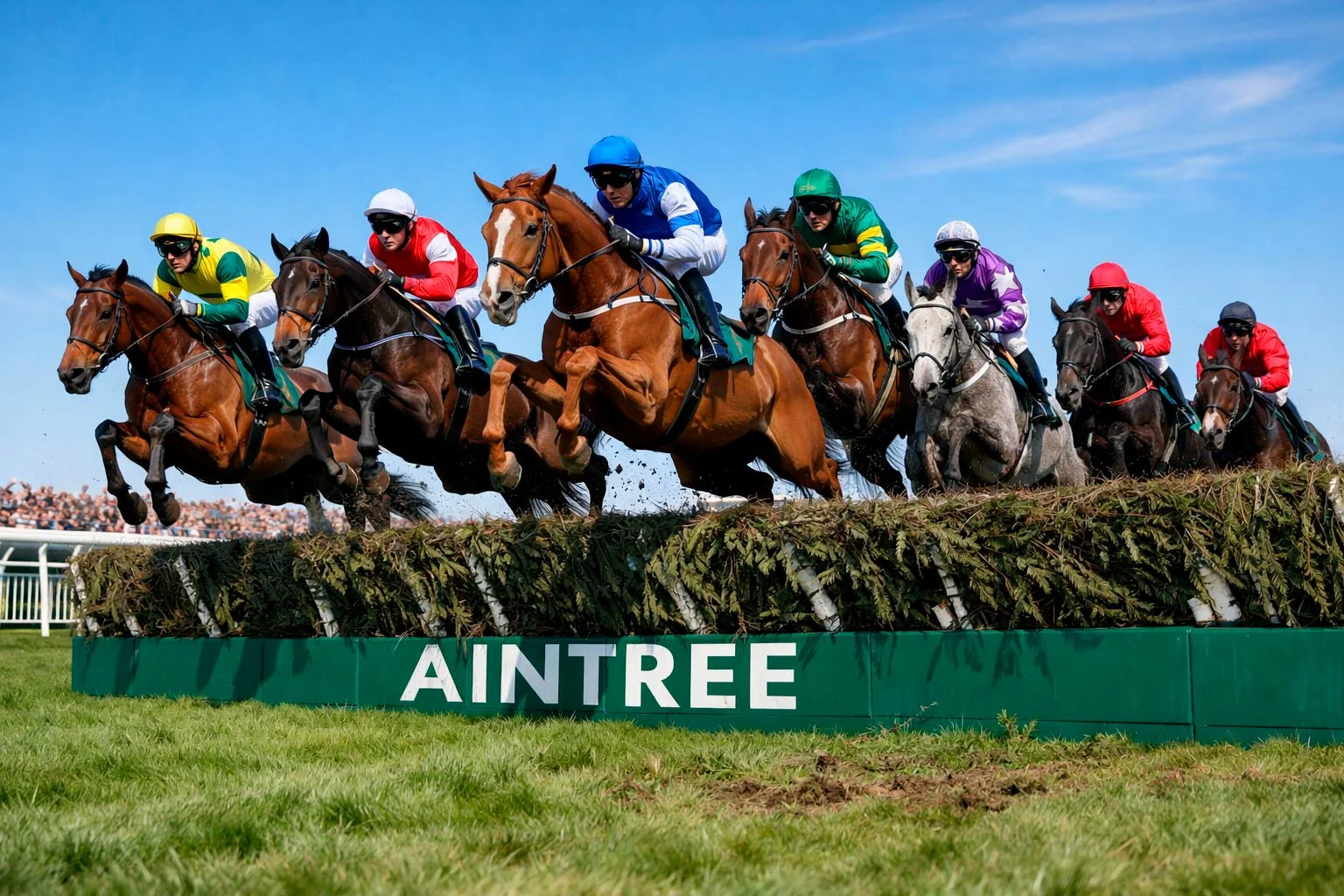
The Grand National is the centrepiece. Betting turnover on the race itself was estimated at over £200 million in 2025, with the full Aintree Festival programme exceeding £250 million. Standard industry terms for the National (40 runners, handicap) are four places at 1/4 odds. Most major bookmakers extend that to five or six places; some push to seven. Bet365's Each Way Extra product allows punters to trade odds for additional places, reaching as high as eight to ten places on selected races — though at reduced fractions that reflect the extended coverage.
The Cheltenham Festival follows a similar pattern. William Hill projected around £450 million in total wagering across the 2026 Festival's four days, making it the most heavily bet racing meeting of the year. Enhanced place offers are standard across all 28 races, with bookmakers typically adding one or two extra places to the Tattersalls terms for the feature handicaps — the County Hurdle, the Martin Pipe, and the Grand Annual among them.
Royal Ascot draws comparable promotional activity, especially on big-field handicaps like the Hunt Cup and the Wokingham.
Evaluating the Real Value
Enhanced places sound generous, and sometimes they are. But when a bookmaker offers seven places instead of four, the win odds are often adjusted downward or the place fraction is reduced from 1/4 to 1/5 to compensate. The way to assess an offer is to calculate the implied probability of each additional place paying out and compare it to the true statistical probability. If the adjusted odds still offer a positive expected return on the marginal positions, the promotion has substance. If the odds have been trimmed to absorb the cost, it is marketing rather than mathematics.
Each-way stakes account for approximately 74–75% of all wagers on the Grand National, according to GrandNational.org.uk, meaning enhanced-place promotions are targeting the vast majority of punters on the UK's biggest race. The implication: do not accept an enhanced offer at face value. Run the numbers, compare the effective place odds against standard terms at a rival bookmaker, and only take the promotion if it genuinely improves your expected return.
The Grand National attracts around 700% more bets than the Cheltenham Gold Cup, according to Entain data — a ratio that reflects the National's unique status as a mass-market betting event where casual and serious punters converge on the same 40-runner handicap.
Tote Pool vs Fixed-Odds Bookmaker: Two Systems, Two Payouts
The UK is one of the few major racing nations where punters can choose between two fundamentally different payout mechanisms on the same race: the Tote pool and the traditional fixed-odds bookmaker. The choice affects not just how much you win, but when you know how much you will win.
How the Tote Pool Works
The Tote operates a pari-mutuel system. All stakes on a given bet type flow into a pool, the Tote deducts its commission (approximately 16.5–28% depending on the bet type, from 16.5% on a Win pool to 28% or more on exotic bets like the Scoop6), and the remainder is shared among winning tickets in proportion to the stakes placed. The dividend per £1 staked is not known until the pool closes. On-course pool betting through the Britbet network turned over more than £73.6 million in 2024, a 26% increase since Britbet's launch in 2018. At the Cheltenham Festival 2025, Britbet's on-course operation posted a record £11.34 million in turnover across the four days.
How Fixed-Odds Bookmakers Settle Place Bets
With a fixed-odds bookmaker, the deal is locked in when you click "place bet." Your return does not depend on other bettors' activity. The bookmaker's margin is embedded in the overround: the sum of implied probabilities across all runners exceeds 100%, and that excess is the theoretical edge. The gross gambling yield from remote horse racing bets reached £766.7 million in 2024/25, according to the UKGC's annual industry statistics, making fixed odds the dominant channel by a wide margin.
When Pool Beats Fixed — and Vice Versa
The most instructive dataset comes from the World Pool, a global pari-mutuel initiative operated by the Hong Kong Jockey Club that merges pools across multiple countries on selected UK meetings. At Royal Ascot 2025, World Pool turnover rose 10% year on year to HK,574.4 million (approximately £150 million) across five days. The World Pool Win dividend beat the official starting price in 20 out of 35 races — meaning pool bettors received a higher payout than fixed-odds punters who took SP in the majority of contests. Exacta pools outperformed the bookmaker Forecast in 23 of 35 races.
"Royal Ascot was absolutely exceptional... World Pool perfectly showcases the enduring appeal of British racing's highest profile flat meeting, particularly with an international audience" — Alex Frost, Chief Executive, UK Tote Group.
The pattern is not universal. Pool dividends tend to overperform on days with deep liquidity — big meetings, international interest. On a quiet Tuesday at Catterick, the pool is shallow and volatile. In those conditions, fixed odds almost always provide a more predictable and often higher return.
The Levy Connection
Both systems feed into the Horserace Betting Levy. Fixed-odds bookmakers pay 10% of their gross profit on British racing to the HBLB, which in 2024/25 collected a record £108.9 million. That 10% of gross profit translates to roughly 0.7% of total turnover — one of the lowest return rates from betting to racing anywhere in the world, according to Trainer Magazine. Together, these flows fund prize money, integrity services and the sport's infrastructure.
There is no universal answer to "Tote or bookmaker?" On big days with deep pools and international liquidity, the Tote can outperform. On quieter cards with thin pools, fixed odds offer certainty and typically better value. The sharp approach is to check both before committing.
Place Betting Strategy: Finding Value in the Each-Way Market
Backing horses each-way is not a strategy in itself — it is a bet type. The strategy lies in how you select which horses to back, at which prices, and under which terms. Three approaches offer a framework for extracting value from the place component of each-way betting.
The Each-Way Thief
The each-way thief targets long-priced horses where the place part alone offers positive expected value, treating any win return as a bonus. In a 16-runner handicap at 1/4 odds, a horse priced at 25/1 returns 25/4 (6.25/1) on the place. If you assess that horse's true probability of finishing in the first four as better than 1-in-7.25, the place part has an edge — regardless of whether it can win. This means looking for exposed handicappers with consistent placed form where the market has priced them for their inability to win rather than their ability to place.
Overround Analysis on Place Markets
Because place odds are derived from win odds via a fixed fraction, any mispricing in the win market is carried through to the place market. In feature races where sharp money compresses the win overround, the place overround can be correspondingly thin — creating better value on the place component of each-way bets than punters might find on quieter cards.
Field Size and Form as Place Filters
Not every race suits each-way betting. Small fields (5–7 runners) pay only two places, which narrows the path to a return. Large handicaps (16+) pay four places at 1/4, widening the scope significantly. The strategic move is to concentrate each-way activity on races where the place terms are most generous relative to the field composition — and where form analysis can identify horses with a high probability of finishing in the frame, even if they are unlikely to win.
The BHA's 2025 Racing Report shows that the market is bifurcating: overall betting turnover on British racing fell 4.3% year on year, but the decline was unevenly distributed. Turnover per race on Premier meetings grew 1.1% on average, while Core meetings saw an 8.1% decline. That divergence suggests sharper bettors and casual punters alike are concentrating their money on the highest-profile fixtures — precisely the events where field sizes are largest, place terms are most favourable, and enhanced promotions add further scope for value.
Place betting is not about hoping for the best. It is about identifying races where the terms, the field size, and the form intersect to create a mathematical edge on the place component — and then sizing your stake accordingly.
Bookmaker Comparison: Place Payout Features at a Glance
Not all bookmakers settle each-way bets on identical terms beyond the Tattersalls baseline. The differences — in Best Odds Guaranteed policies, enhanced place availability, maximum payouts, and each-way extras — can materially affect your return on the same horse in the same race. The table below compares the features most relevant to place payout across the major UK operators.
| Feature | bet365 | William Hill | Paddy Power | Betfair Sportsbook | Ladbrokes |
|---|---|---|---|---|---|
| Standard place terms | Tattersalls | Tattersalls | Tattersalls | Tattersalls | Tattersalls |
| Best Odds Guaranteed | Yes (UK/IRE) | Yes (UK/IRE) | Yes (UK/IRE) | Yes (selected) | Yes (UK/IRE) |
| Enhanced places on big races | Frequent | Frequent | Frequent | Occasional | Frequent |
| Each Way Extra (trade odds for places) | Yes (up to 10 places) | No | No | No | No |
| Place-only betting | No (EW only) | No (EW only) | No (EW only) | Yes (exchange) | No (EW only) |
Best Odds Guaranteed (BOG) is now near-universal for UK and Irish racing, meaning if the starting price exceeds your fixed price, the bookmaker pays at SP instead. This applies to both win and place parts of each-way bets — a risk-free upside that is particularly valuable for early-morning prices that shorten by post time.
Bet365's Each Way Extra stands out as a unique product. It lets punters increase the number of paid places by accepting reduced odds — effectively customising place terms rather than accepting the Tattersalls default. Whether this represents value depends on the specific field and the odds adjustment applied.
The competitive environment is shifting. Average turnover per race fell 8% year on year in 2024/25, with a cumulative 19% decline over three years. That sustained contraction pressures bookmakers to attract customers through promotional generosity — which, for now, works in favour of the each-way punter willing to shop around.
Frequently Asked Questions
What is the UK equivalent of a show bet?
The UK does not have a standalone show bet. The closest equivalent is the place part of an each-way bet, which pays out if your horse finishes within the paid places — typically the top two, three or four, depending on the number of runners and whether the race is a handicap. The key structural difference is that a US show bet is settled through a pari-mutuel pool, where the payout depends on total money wagered, while the UK place part is settled at fixed odds: a fraction (1/4 or 1/5) of the win price quoted by the bookmaker. You can also bet place-only through the Tote, which operates a pari-mutuel pool on British racecourses, but this is a separate product from each-way betting with a traditional bookmaker.
How is the place payout calculated in UK horse racing?
The place payout on an each-way bet is calculated by multiplying the win odds by the place fraction (1/4 or 1/5, as set by Tattersalls Rules for that race), then multiplying by your stake and adding the stake back. For example, if you back a horse at 10/1 each-way in a race paying three places at 1/5 odds, the place calculation is: 10/1 × 1/5 = 2/1. On a £10 place stake, that returns (£10 × 2) + £10 = £30.00. If Rule 4 deductions apply due to a non-runner, the deduction is taken from the winnings portion only — not the returned stake. Dead heats at the boundary of a paid place divide the stake by the number of horses involved before applying the odds.
How many places are paid and what are the standard place terms?
Standard UK place terms under Tattersalls Rules depend on the number of runners and the race type. In races with 2–4 runners, there is no place betting — it is win only. With 5–7 runners, two places are paid at 1/4 of the win odds. In non-handicap races with 8–11 runners, three places are paid at 1/5 odds. Handicap races with 8–15 runners pay three places at 1/4 odds. Handicaps with 16 or more runners pay four places at 1/4 odds. These are the standard terms; bookmakers may enhance them for promotional purposes on major races like the Grand National or Cheltenham Festival, sometimes extending to five, six or even ten places at adjusted fractions.
Glossary of Key Betting Terms
Show Bet — A US pari-mutuel wager on a horse to finish in the top three. No standalone UK equivalent; the closest is the place part of an each-way bet.
Place Bet — A bet on a horse to finish within the paid places. Available in the UK as part of an each-way bet or as a standalone Tote pool bet.
Each-Way (EW) — Two bets in one: a win bet and a place bet at equal stakes. Total cost is double the stated stake.
Place Terms — The conditions governing how many positions are paid and at what fraction of win odds, set by Tattersalls Rules.
Place Fraction — The proportion of win odds paid on the place part. Typically 1/4 or 1/5 in UK racing.
SP (Starting Price) — The official odds at the moment the race begins, determined by the on-course market.
BOG (Best Odds Guaranteed) — A bookmaker promotion paying at the higher of your fixed price or SP.
Rule 4 — A Tattersalls rule applying a deduction to winnings when a horse is withdrawn after the market has formed. Scale ranges from 90p to 0p per pound.
Dead Heat — When two or more horses cannot be separated at a finishing position. The stake is divided by the number involved before settlement.
Tote — The UK's pari-mutuel betting operator. Stakes are pooled, commission deducted, and the remainder shared among winners as a dividend.
Pari-Mutuel — A pool-based betting system where the payout depends on total money wagered, not fixed odds. Used by the Tote and all US racetracks.
Fixed Odds — A system where the payout is locked at bet placement. The standard model for UK bookmakers.
Accumulator (Acca) — A multi-selection bet where returns roll through each leg. All selections must win (or place, in an EW acca).
Overround — The bookmaker's built-in margin: the percentage by which implied probabilities exceed 100%.
Field Size — The number of declared runners. Directly determines place terms.
Handicap — A race where horses carry different weights to equalise chances. Typically draws larger fields and more generous place terms.
Ante-Post — A bet placed before final declarations. Not subject to Rule 4, but the stake is lost if the horse does not run.
